LNG Markets Explained: Pricing, Supply & Demand
As global energy markets become more interconnected, LNG plays a critical role in shaping prices, supply chains, and business decisions worldwide. Understanding how LNG markets operate helps companies manage risk, control costs, and respond faster to shifting global demand.In This Article
Quick links to sections in this article.
LNG markets are the global systems where liquefied natural gas is produced, shipped, priced, traded, and delivered to buyers that need flexible energy supply. They matter because a cargo decision in Qatar, the US, Japan, China, Europe, or the Middle East can shift prices, and industrial costs in real time.
What Drives LNG Markets?
LNG markets are shaped by three key forces: available supply, buyer demand, and transport flexibility. Unlike pipeline gas and fuel, liquefied natural gas can move across oceans, so cargoes often flow toward the region willing to pay the highest netback price.
The market became more one of the core financial concepts after Europe reduced reliance on Russian gas. EU buyers competed harder for flexible cargoes, while Asian importers such as Japan, South Korea, China, and India adjusted purchases based on price sensitivity.
What’s the biggest news? According to the IEA, global LNG supply grew strongly in the second half of 2025, easing tight fundamentals, while it expects in 2026 to keep growing and bring faster supply growth as well as reach a bigger potential of demand.
LNG Pricing: Why Prices Move Quickly
LNG pricing depends on contract structure, regional benchmarks, shipping costs, and the balance between spot and term supply. A cargo may be linked to Henry Hub, TTF, JKM, or a hybrid pricing formula.
Spot prices move quickly when weather, conflict, plant outages, or shipping disruptions affect available cargoes. For example, a cold winter in Europe or strong summer power demand in Asia can raise competition for the same flexible LNG cargo.
In 2025, the IEA data reported that European and Asian benchmark prices were closely correlated, reflecting the increasingly connected nature of LNG markets as destination-flexible supply expands.
The LNG Supply Chain
The LNG supply chain starts with natural gas production, then moves through processing, liquefaction, shipping, regasification, and final delivery. Each stage adds cost, risk, and timing constraints.
Here’s a simplified view:
This is why supply-chain visibility matters. Companies that understand how supply chains differ from logistics can assess LNG cargo risk more accurately.
In volatile markets, knowledge is the strongest energy advantage.
Supply: The New Capacity Wave
LNG markets are entering a major capacity cycle. The United States, Qatar, Canada, and parts of Africa are expanding liquefaction capacity, while new terminals are changing import options in Europe and Asia.
The EIA forecasts U.S. LNG exports to average 17.0 Bcf/d in 2026 and rise again in 2027 as projects ramp up. It also notes that U.S. exports to Europe reached a record 10.3 Bcf/d in 2025.
Whereas Golden Pass shipped its first cargo in April 2026 and is expected to add major capacity when all trains are complete. The EIA said the terminal’s full nominal one will be around 2.0 bcf/d.
Demand: Asia, Europe, and Industrial Use
LNG market demands depend on power generation, industrial activity, weather, policy, and affordability. China and emerging Asian markethalls are expected to support stronger growth in 2026, according to the IEA.
Europe remains important because storage refill, lower Russian pipeline flows, and energy security policy keep LNG imports strategically relevant. Asian buyers, meanwhile, often switch between spot purchases, long contracts, coal, renewables, and domestic gas depending on prices.
For business leaders, this means LNG is not just an energy input. It affects manufacturing margins, treasury exposure, procurement decisions, and national energy security.
Natural Gas Trading and Risk Management
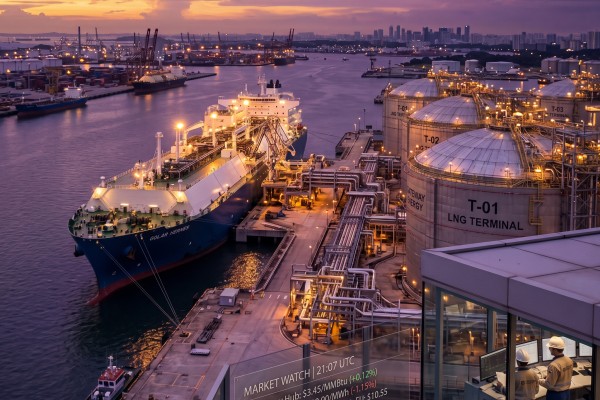
Natural gas trading in LNG requires more than watching price charts. Traders track vessel movements, storage levels, weather forecasts, liquefaction outages, shipping routes, and geopolitical events.
A utility buying winter cargoes for Europe may hedge TTF exposure, while an Asian buyer may compare JKM prices with oil-indexed term contracts. A producer may prefer long offtake to secure project financing.
The finance team must also understand credit lines, collateral, currency exposure, and working capital. LNG procurement is therefore closely linked to corporate treasury management, especially when cargo values move sharply.
Gas Market Trends to Watch
Current gas market trends point to a more liquid but still volatile industry. New supply can soften prices, but shocks can still come from the Strait of Hormuz, plant outages, Panama Canal restrictions, sanctions, or sudden weather events.
GIIGNL reported 406 MT of global LNG trade in 2024, with 492 MTPA of liquefaction capacity and 1,188 MTPA of regasification capacity, showing the scale and infrastructure depth of modern LNG markets.
The next decade may bring more flexible contracts, larger U.S. export volumes, more Asian demands, and stronger competition between spot and term buyers. Yet volatility will remain because LNG still depends shipping windows, and policy decisions.
Why LNG Markets Matter for Business Decisions
LNG markets influence power costs, industrial competitiveness, inflation, and investment planning. A price shock can raise input costs for chemicals, fertilisers, steel, cement, and electricity-intensive manufacturing.
Executives need three practical capabilities:
- Read supply signals before prices move.
- Compare spot, term, and indexed contract exposure.
- Connect energy risk with finance, procurement, and operations.
For readers building stronger commercial judgement, Regent’s Advanced Natural Gas and LNG Markets Trading Training Course provides structured training on pricing, trading, contracts, and market analysis.
Conclusion
LNG markets are becoming larger, more flexible, and more connected. Supply growth from new liquefaction projects may ease pressure, but demand shifts, shipping risk, and geopolitical events can still transform prices quickly.
For leaders, the value is practical: better LNG insight improves purchasing, trading, budgeting, and risk strategy. In a volatile energy decade, understanding LNG markets is no strategy longer only a trader’s skill; it is a strategic business capability.
Posted On: May 29, 2026 at 05:44:07 PM
Last Update: May 29, 2026 at 05:44:07 PM
LNG markets are global trading systems for liquefied natural gas, covering production, shipping, pricing, contracts, and final delivery.
LNG prices react to weather, shipping disruptions, outages, storage levels, Asian demand, European imports, and geopolitical risk.
The United States, Qatar, Australia, Russia, and Malaysia are major exporters, with the U.S. currently playing a leading global role.
Companies use it to manage procurement, hedge exposure, forecast energy costs, and support investment decisions.
Articles You Can’t Miss
Handpicked content to fuel your curiosity.