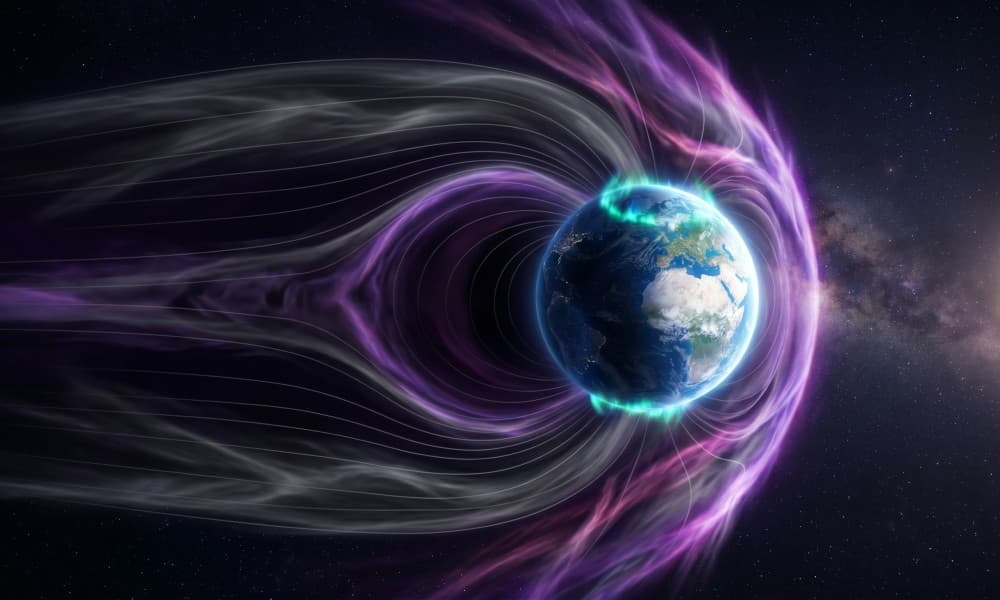
Smile Spacecraft Begins Mission to Reveal Earth's Hidden Magnetic Shield
The greatest shields are often the ones we cannot see.In This News
Quick links to sections in this news.
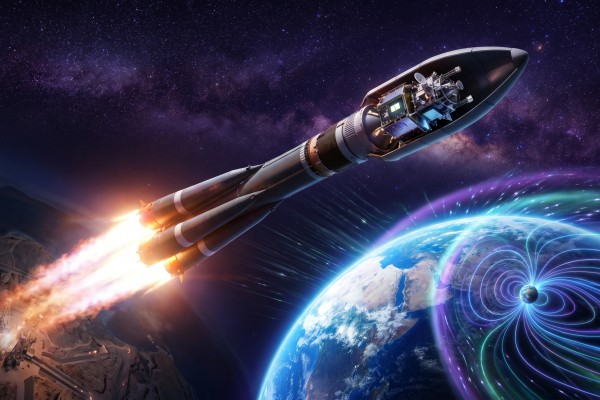
On May 19, 2026, at 04:52 BST, the Smile mission—a collaborative effort between the Chinese Academy of Sciences (CAS) and the European Space Agency (ESA)—successfully launched from Europe's Spaceport in French Guiana on a Vega C rocket.
Confirmation of spacecraft health came swiftly: the first signal arrived at ESA's New Norcia station at 06:48 CEST, and solar panels were deployed one minute later, providing electricity for the journey ahead.
Smile aims to observe the northern lights continuously for up to 45 hours and take the first-ever X-ray images of Earth's magnetosphere.
Director General Josef Aschbacher praised the launch as a watershed occasion, stating that scientists can now observe “Earth's invisible armour in action” after decades of unanswered questions about how the planet withstands the solar wind.
A New Era for Understanding Earth's Magnetic Defences
For billions of years, Earth's magnetic field has protected the planet from charged particles coming from the Sun. Without this protective bubble—the magnetosphere—the solar wind would strip Earth's atmosphere and turn it into a barren planet.
Moreover, Smile's equipment is intended to disclose how this defensive system actually works by utilising X-ray and ultraviolet imaging to track the chain reaction that occurs when solar particles clash with the magnetic border.
According to Carole Mundell, Director of Science at ESA, Smile builds on the legacy of missions like Cluster and XMM Newton, but uniquely uses their technology to provide the first global, real-time perspective of magnetospheric dynamics.
Additionally, the mission's ultraviolet camera will record the entire northern lights ring in previously unheard-of clarity, offering the longest continuous observations of the auroral oval since 2008.
Core International Collaboration
Smile is the first mission that ESA and CAS have selected, designed, built, launched, and operated together. Despite difficulties like travel restrictions during the pandemic, ESA Project Manager David Agnolon emphasised the smooth collaboration across countries.
Notably, three of the four science instruments, including the X-ray and ultraviolet cameras, are located in the spacecraft's payload module, which was constructed by Airbus Defence and Space in Spain.
Likewise, Europe has made significant contributions: the X-ray telescope, Smile's largest instrument, was developed in the United Kingdom in collaboration with 14 other countries. ESA's €130 million investment covers over 40 firms and institutes, with an average cost of only 28 cents per European resident.
Hundreds of engineers and scientists have already contributed to the project, and many more will study its results in the coming years.
With Regent Training Centre's helping hands, trainees can enhance performance and realise their career goals. Customised coaching and practical instruction strengthen abilities and develops self-assurance.
Travelling to Orbit and the Future of Science
The Vega C rocket was chosen for its precise match to Smile's mission profile. Over the following month, the spacecraft will fire 11 engines to reach its highly elliptical orbit—soaring 121,000 km above the North Pole to collect data, then descending to 5,000 km above the South Pole to send it back to Earth.
Scientific activities are scheduled to commence in July, after the booms are deployed, camera covers are opened, and all systems are confirmed.
Further, ESA's Smile Project Scientist, Philippe Escoubet, states that the data collected by Smile will enhance our understanding of Earth and the Solar System, as well as improve models of Earth’s magnetic environment, contributing to the safety of astronauts and space technologies for the future.
Read more news:
Posted On: May 19, 2026 at 07:10:01 PM
Last Update: May 19, 2026 at 07:10:01 PM
Articles You Can’t Miss
Handpicked content to fuel your curiosity.


