China Establishes a Regular Arctic Shipping Route to Europe Amid the Hormuz Crisis
When traditional trade routes narrow, global commerce seeks new paths—but the shortest route is not always the safest.In This News
Quick links to sections in this news.
Escalating turmoil in Middle Eastern chokepoints, such as the U.S. war on Iran, the closure of the Strait of Hormuz, and Houthi attacks on Saudi-linked shipping near the Bab al-Mandeb Strait, has compelled global trade to explore alternative maritime corridors.
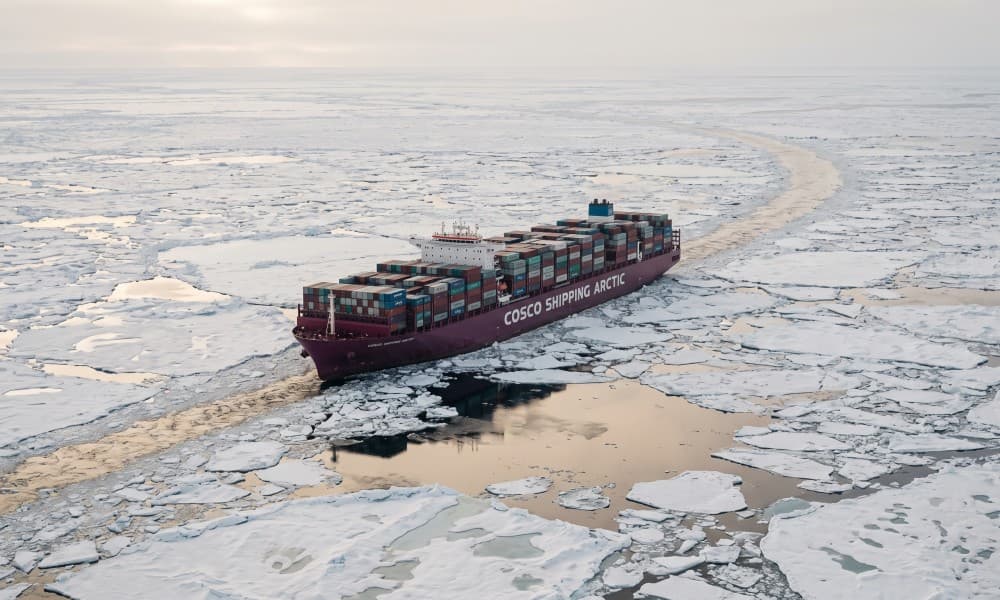
U.S. Secretary of State Marco Rubio highlighted the need for a significant shift in global energy commodity flows due to Iran's perceived threat. In reaction, China is promoting its ‘Polar Silk Road,’ exemplified by the Sea Legend carrier launching the first regular commercial container service via Russia's Northern Sea Route (NSR).
Operating a route from Ningbo-Zhoushan to Felixstowe significantly shortens transit times to 18–21 days, compared to over 40 days through the Suez Canal. Sea Legend's COO, Li Xiaobin, pointed out that recent Middle East crises have highlighted vulnerabilities in traditional routes, necessitating the development of alternatives.
Additionally, the cold environment of this route is suitable for transporting heat-sensitive cargo such as electric vehicles and lithium-ion batteries.
Strategic Partnerships & Access Limitations
Beijing's Arctic ambitions began in 2017, but access to the Northern Sea Route (NSR) was restricted until Moscow, facing international isolation post-2022, increased its dependency on China. Currently, Rosatom manages permitting and icebreaker support, allowing China significant access to the NSR.
Notably, a senior analyst at the International Crisis Group, William Yang, notes that Russia’s control over the Northern Sea Route (NSR) makes China the only viable user of this route as an alternative to the Strait of Hormuz or the Suez Canal. He highlights that most vessels using the NSR are Russian shadow fleets subjected to international sanctions, which presents potential political risks for other countries involved.
Despite Beijing's efforts, experts note that the corridor faces limitations due to seasonal windows, high operating costs, and dependence on Russian infrastructure subject to sanctions.
Climate Risks & Environmental Vulnerabilities
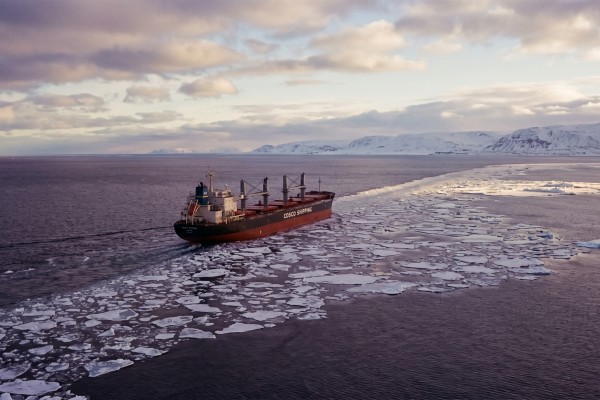
Shorter maritime transits may lower greenhouse gas emissions, but experts caution significant environmental risks to the vulnerable Arctic ecosystem. A record 5.8 per cent reduction in winter ice extent from 2024 to 2025 has lengthened the navigation season, increasing ecological vulnerability.
Besides, the use of heavy fuel oil (HFO) carries significant risks of oil spills in remote, icy waters, which are difficult to remediate and contribute to polar warming through black carbon emissions. Capt. Nitin Chopra from Allianz stresses that the isolation of these regions increases the likelihood of machinery failures, which could lead to environmental oil spills in sensitive ecosystems.
Further, a professor at RMIT University, Vinh Thai, pointed out the significant economic and ecological consequences of a major spill, describing it as an “environmental as well as economic disaster” for Russia and its surroundings. He concluded that the northern sea route cannot currently substitute the Strait of Hormuz or the Suez Canal.
Effects on International Trade & Security Dynamics
Analysts perceive the Ice Silk Road as a seasonal hedge rather than a permanent replacement for traditional trade routes, heightening great-power competition in the Arctic. Dylan Loh from Nanyang Technological University emphasises that the route's effectiveness is reliant on ice melting, introducing uncertainty, and that it currently serves as a hedge for China, not a complete shift in global power dynamics.
Ultimately, expanding on strategic implications, Alejandro Reyes of the University of Hong Kong noted China's longstanding interest in the Arctic, being an observer in the Arctic Council since 2013. He highlighted that regular shipping adds economic significance to this presence, suggesting Europe could gain from a shorter route to Asia while increasing reliance on a Russia-controlled corridor, ultimately serving as a strategic asset for Beijing rather than a complete substitute for Middle Eastern waterways.
Regent Training Centre promotes professional growth by providing Customised Coaching and practical skills training, allowing students to improve their performance and confidently pursue long-term career goals.
Read more news:
Posted On: August 19, 2026 at 01:59:58 PM
Last Update: August 19, 2026 at 01:59:58 PM
Articles You Can’t Miss
Handpicked content to fuel your curiosity.