
NASA Plans to Establish a $20 Billion Lunar Base
Building Humanity’s Future Beyond EarthIn This News
Quick links to sections in this news.
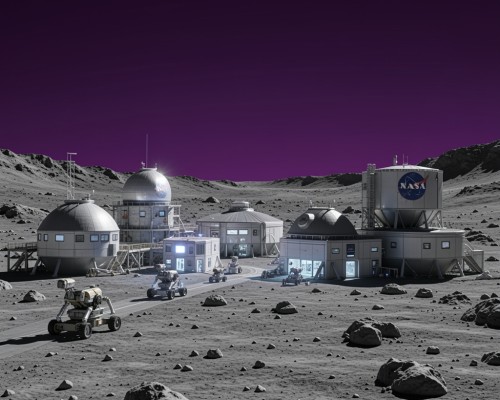
NASA Administrator Jared Isaacman revealed intentions for a $20 billion lunar base designed to establish a lasting presence on the Moon, announced during NASA’s Ignition event. He also discussed plans to launch a nuclear-powered spacecraft to Mars.
Significantly, NASA is pausing its Gateway project, intended to create a space station orbiting the Moon, in favour of focusing on infrastructure for sustained surface operations.
The agency plans to repurpose some equipment from the Gateway project for this new initiative.
NASA Plans a $20 Billion Three-Phase Moon Base
NASA plans to build a lunar base in three phases: initially developing communications and navigation systems and deploying robotic landers and vehicles, followed by recurring astronaut operations on the Moon's surface, and ultimately establishing a long-term human presence with the infrastructure for a permanent base.
Remarkably, Isaacman announced an investment of approximately $20 billion over the next seven years to construct the base through multiple missions, though no timeline for completion was provided.
In addition, to establish a lunar base suitable for human habitation, NASA must address severe temperature fluctuations, harmful space radiation, low gravity's effects on physical health, and the threat posed by micrometeorites.
Regent Centre offers corporate Consulting Services that transform intricate organisational difficulties into actionable strategies in leadership, human resources, finance, operations, and digital transformation, delivering real solutions for long-term growth.
Isaacman Warns China as NASA Eyes 2028 Mars Craft
President Donald Trump selected billionaire entrepreneur Isaacman to lead NASA in 2024, initially withdrawing the nomination before reinstating it. In his second confirmation hearing, Isaacman highlighted the increasing competition with China, asserting that it possesses the "will and means to challenge American exceptionalism" in space.
Furthermore, Isaacman emphasised the urgency of the space race, stating that success in the competition will be measured in months. He noted that China plans to land humans on the Moon by 2030 and establish a lunar base, while NASA has postponed its Artemis Moon landing mission to 2028.
Basically, NASA plans to launch the Space Reactor-1 Freedom, the first nuclear-powered interplanetary spacecraft, to Mars by the end of 2028. Upon arrival, it will deploy a payload containing helicopters akin to Ingenuity, which achieved the first powered flight on Mars in 2021.
Read more news:
Posted On: March 27, 2026 at 09:03:16 AM
Last Update: June 8, 2026 at 06:37:01 PM
Articles You Can’t Miss
Handpicked content to fuel your curiosity.