AI Solves Math Problems, Sparks Concerns
Scientific Breakthrough Sparks Astonishment and Concerns Over the Future of Academic Research and Human CreativityIn This News
Quick links to sections in this news.
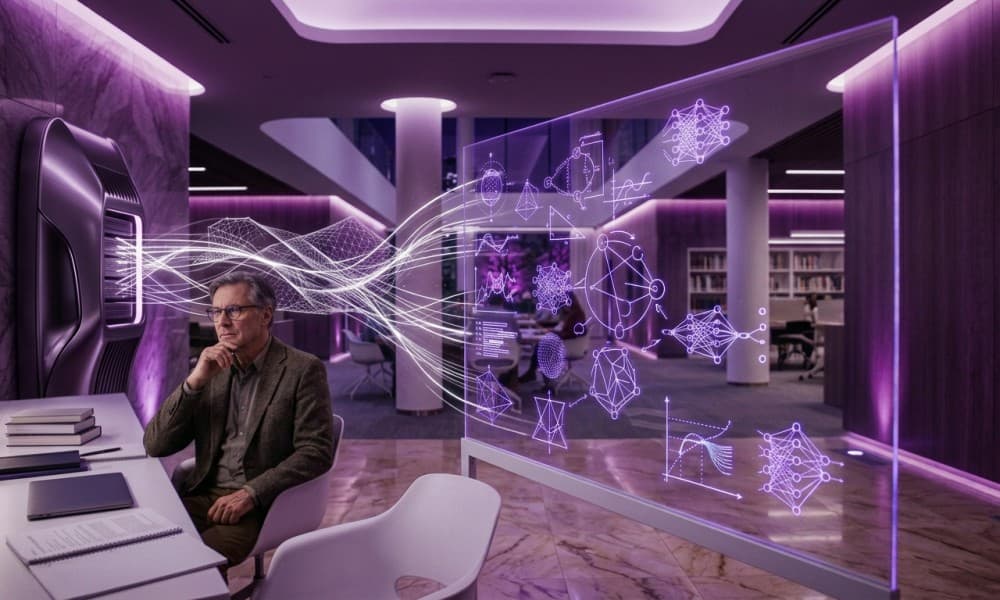
Mathematicians are astonished by the rapid advancements in artificial intelligence, which have recently addressed some of the most challenging open math problems previously unsolvable by humans.
OpenAI has recently presented mathematicians with an extensive array of findings across diverse mathematical fields, including algebra, number theory, theoretical computer science, mathematical logic, and topology.
The 377 results are a continuation of OpenAI's announcement regarding its success in solving the Navier-Stokes equation, one of the Millennium Problems, each with a $1 million reward for solutions.
AI Math Advances Raise Questions of Originality
This achievement highlights the capabilities of advanced artificial intelligence models but also raises concerns about the nature of their creativity—questioning whether they are genuinely inventive or merely finalising proofs based on human mathematicians' ideas.
New mathematical solutions similar to the Navier-Stokes result utilised a more advanced A.I. model that is not publicly available.
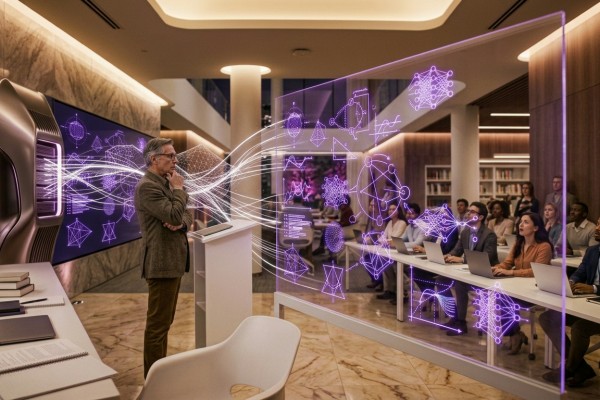
Moreover, OpenAI is collaborating with an advisory board of mathematicians to guide the communication of A.I.-produced results. This independent group, hosted by the Institute for Advanced Study in Princeton, N.J., aims to enhance transparency between A.I. companies and the mathematical community.
Among other recommendations, the advisory board has proposed that all prompts to A.I. agents and their thought processes be made public. In a statement released on Tuesday night, the board emphasised that this initiative is “the beginning, not the completion, of the process of human understanding and the incorporation of the work into mathematical knowledge.”
Regent Centre specialises in Corporate Consulting Services, offering actionable strategies to address complex organisational challenges in leadership, human resources, finance, operations, and digital transformation. Their services aim for practical solutions that enable sustainable progress, helping organisations navigate complexities and achieve their objectives.
AI Math Breakthroughs Prompt Calls for Oversight
A Harvard mathematician and advisory board member, Melanie Wood, expressed the aim of establishing standards and practices to ensure that outcomes from A.I. labs are comprehensible to mathematicians and contribute to the advancement of the field.
Many proofs were verified using Lean, a computer language ensuring logical accuracy. For 10 solutions, the company provided summaries of the A.I. model's reasoning. On average, each result required about three hours of computation, according to the company. OpenAI noted that they utilised external advice and public recommendations to guide the results' release.
Meanwhile, OpenAI appears to disregard a crucial recommendation from its advisory board, which suggested that A.I. companies cease testing their proprietary models on advanced mathematical problems. In a statement issued on September 29, the advisory board clearly articulated their disapproval of this practice.
Companies have subjected their models to math challenges akin to those faced by high school students in the International Mathematical Olympiad, which serve as performance benchmarks.
On Tuesday, the OpenAI team unveiled new benchmarks of unsolved math problems, developed after their models successfully identified specific challenges in mathematical research.
AI Solves Faster, Understanding Lags
The research lead at OpenAI, Dan Roberts, asserted the significance of testing these internal models to enhance their capabilities. Notably, the resulting proofs emerged as a secondary outcome from this rigorous testing process.
A mathematician from New York University, Tristan Buckmaster, expressed concerns regarding the implications of A.I. models, like those developed by OpenAI, on mathematicians working on problems such as the Navier-Stokes equation. He questioned whether mathematicians were unknowingly providing insights that enabled A.I. to surpass them in achieving final results.
Furthermore, Dr. Buckmaster suggested that A.I. might utilise existing work to reach conclusions faster, indicating a lack of thorough validation in the release of these multiple results. He underscored that this raises significant issues about due diligence in research practices.
Mathematicians are currently debating the implications of the rapid pace at which mathematical problems are being solved, particularly when understanding of the solutions does not keep up.
In the end, a graduate student in mathematics at the University of Toronto, Kai Shaikh, suggests that this dilemma reflects a conflict between two human inclinations: the competitive drive and the ability to appreciate beauty. He argues that the competitive nature may be undermining the capacity for deeper appreciation in mathematics.
Read more news:
Posted On: October 14, 2026 at 02:07:46 PM
Last Update: October 14, 2026 at 02:09:01 PM
Articles You Can’t Miss
Handpicked content to fuel your curiosity.