Apple Overtakes Nvidia to Reclaim the Title of Most Valuable Company Worldwide
Innovation drives growth, but strategy sustains it.In This News
Quick links to sections in this news.
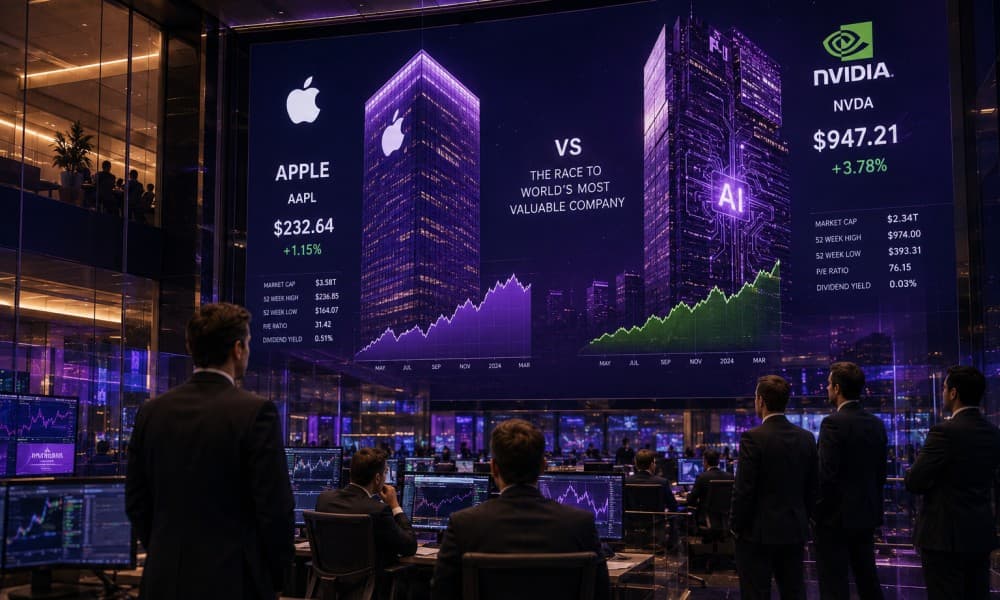
As investors reevaluate the prospects for artificial intelligence, Apple overtook Nvidia on Friday to become the most valuable company in the world, shifting the top ranks of tech giants.
Apple's market valuation was last recorded at $4.88 trillion, maintaining steady share prices, while Nvidia's valuation stood at approximately $4.86 trillion following a 3.5% decline.
In October, Nvidia made history as the first company to exceed a $5 trillion market valuation, entering a rarefied level of financial achievement unattainable by its competitors.
Apple Overtakes Nvidia as Top AI Stock Target
Apple's rise does not imply a permanent shift in market dynamics, as the chipmaker continues to benefit significantly from AI investments, with its graphics processors driving much of the generative AI trend.
Amid the rising interest in artificial intelligence (AI), there is a notable shift in the investment landscape, with investors expanding their attention beyond key players like Nvidia, which previously dominated for nearly a year.
Moreover, Apple has regained its position as the leading focus for investors, marking its first resurgence since April of the previous year.
The Head of Investment at BRI Wealth Management, Toni Meadows, noted that while Apple was perceived as lagging in AI development due to its limited investment in model development, recent sentiment has shifted positively towards the company.

Before Handover, Siri AI Push Tests Cook's Legacy
Last month, Apple launched a significant upgrade for Siri, aiming to enhance its competitiveness against major tech companies and emerging startups in the AI industry.
This rollout is seen as a crucial step for Apple, which has often been perceived as lagging in AI advancements. The initiative may influence the legacy of CEO Tim Cook, who is set to hand over leadership to hardware expert John Ternus in September.
Nvidia is positioned to potentially reclaim its leading status if market sentiment changes. In contrast, Apple faces challenges from its decision to increase prices to address rising costs, which may adversely affect consumer demand.
Meanwhile, Benjamin Hall, vice-president of alpha research at Segal Marco Advisors, remarked that he sees no significant differences in the competitive landscape, highlighting Nvidia's likely continued prominence in future developments.
AI Memory Boom Diversifies Tech Market
In recent developments, enthusiasm for AI has permeated the semiconductor industry, particularly benefiting memory chipmakers.
Notably, Micron achieved a market value exceeding $1 trillion in May, reflecting investors' growing recognition of the pivotal role of memory chips in AI infrastructure.
Additionally, South Korea's SK Hynix made its debut on the Nasdaq this month, further intensifying competition for investor interest.
Hall mentioned that the arrival of new entrants in the market might shift the focus from the select “Magnificent Seven” stocks to a broader array of companies.
In essence, the significant rally in semiconductor stocks faced challenges in July as investors began to question the long-term viability of the artificial intelligence sector, resulting in a nearly 19% decline in the Philadelphia SE Semiconductor index from its peak.
Nonetheless, the index has outperformed Nvidia year-to-date despite this downturn.
Regent Training's Online Courses can help participants improve their efficiency and achieve their professional ambitions while additionally acquiring skills and confidence in themselves.
Read more news:
Posted On: July 20, 2026 at 07:21:08 PM
Last Update: July 20, 2026 at 07:21:39 PM
Articles You Can’t Miss
Handpicked content to fuel your curiosity.