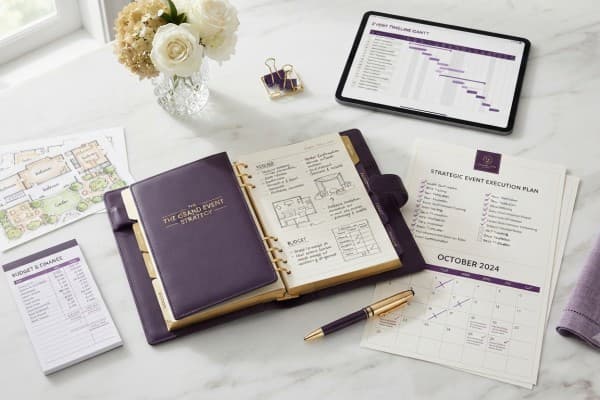
Event Budget Planning: How to Control Costs Without Sacrificing Quality
Effective event budget planning helps organizations control costs without compromising quality. By setting clear financial goals, managing risks, tracking expenses, and making smarter decisions, teams can create successful events that deliver measurable value and memorable experiences.In This Article
Quick links to sections in this article.
Event budget planning is the structured process of estimating, approving, tracking, and reviewing every financial commitment linked to an event. A strong budget protects the attendee experience because it directs money towards the elements that support the objective while reducing waste, late fees, and unapproved expenses.
Cost control does not mean selecting the cheapest option. It means creating a realistic plan, comparing value, setting financial limits, and making trade-offs before suppliers or stakeholders make them for you.
Why Event Budget Planning Matters
Event budget planning gives leaders a reliable basis for deciding whether an event is affordable, commercially justified, and operationally realistic. It also makes the effect of every change visible before the team commits money.
The Project Management Institute explains that a cost baseline is needed to compare planned work with actual costs. The same principle applies to events: without an approved baseline, overspend can be identified only after it has occurred.
Current industry guidance also places greater emphasis on proving value, not merely reporting attendance. Cvent’s 2026 industry review identifies rising costs and economic uncertainty as reasons to design more efficient experiences, while PCMA recommends defining how and when performance indicators will be measured from the outset.
1. Start With the Objective and Financial Limits
Begin event budget planning by stating what the event must achieve. A conference designed to generate qualified sales opportunities needs a different plan from a staff meeting, charity dinner, customer party, or newsroom briefing.
Set three figures before detailed planning begins:
- The maximum approved budget
- The target cost per attendee
- The minimum acceptable ROI or return on objectives
A technology company, for example, may accept higher production costs for a product demonstration if the event supports a measurable pipeline. A community charity may prioritise accessibility, volunteer support, and net income instead.
Create a short business case that includes expected attendance, income, fixed costs, variable costs, assumptions, risks, and success measures. Before the kick-off meeting, this step gives the planner and sponsor a shared basis for later decisions.
2. Build a Complete Cost Structure
Effective event budget planning separates costs into categories that can be estimated, negotiated, tracked, and reviewed. It should include direct expenses, internal labour, tax, contingency, cancellation exposure, and costs that are often hidden in another department.
| Budget Category | Typical Items | Main Control |
| Venue | Hire, security, cleaning, utilities | Compare total package cost |
| Food and beverage | Menus, service, dietary needs | Confirm minimum spend and final numbers |
| Production | Sound, lighting, staging, screens | Define specifications before quotation |
| Speakers | Fees, travel, accommodation | Agree scope and cancellation terms |
| Marketing | Creative work, media, email, print | Track cost per registration |
| Technology | Registration, apps, streaming, data | Remove duplicate tools |
| Staffing | Hosts, technicians, medical cover | Match staffing to risk and attendance |
| Travel | Transport, hotels, transfers | Set booking deadlines and rate caps |
| Contingency | Identified financial risks | Link reserve to the risk register |
A useful budget template includes estimate, approved amount, committed amount, actual amount, forecast, variance, supplier, payment date, owner, and approval status. These fields make managing multiple contracts much easier.
Leaders who need a stronger financial foundation can review core financial concepts before approving large events. Understanding fixed and variable costs, cash flow, break-even points, and variance improves decision quality.
A successful event is not measured by how much you spend, but by how wisely you invest every decision.
Plan Smarter Today3. Use Three Budget Scenarios
Create minimum, expected, and enhanced budgets. This approach lets the team respond quickly when attendance, sponsorship, venue availability, or corporate priorities change.
The minimum plan protects essential quality: safety, accessibility, reliable production, clear communication, and adequate service. The expected plan funds the approved experience, while the enhanced plan includes optional upgrades with an evidence-based benefit.
For example, a conference may retain professional sound and stage management in every scenario but place premium entertainment, decorative installations, and additional filming in the enhanced option. This protects quality without treating every request as essential.
4. Estimate Costs With Evidence
Good event budget planning uses supplier quotations, previous events, market benchmarks, and documented assumptions. Do not copy last year’s figures into an Excel template without checking changes in capacity, location, scope, tax, labour, or inflation.
Request comparable quotations using one written brief. Explore alternative specifications, and ask each supplier to show unit prices, quantities, exclusions, overtime, delivery, cancellation, and optional items.
Store evidence in controlled Excel or Google Sheets files. A customizable template should show the source and date of every estimate so reviewers can distinguish confirmed figures from assumptions. Use an industry blog only as supporting context, never as the sole basis for a cost estimate.
Use a PDF version for approval, but retain the live planning file as the master. A PDF protects the approved baseline; Excel or Google Sheets supports forecasting and updates.
5. Protect Quality by Defining It
Quality must be translated into measurable requirements. “High-quality catering” is vague; “hot lunch served to 400 people within 35 minutes, with confirmed dietary alternatives” can be priced and tested.
Apply the same method to sound, lighting, registration, accessibility, security, speaker support, room design, and online delivery. Clear standards allow suppliers to propose efficient formats without lowering the result.
ISO 20121:2024 provides a management framework for the social, economic, and environmental impacts of events of every type and size. Its approach supports more disciplined decisions about procurement, waste, resources, stakeholders, and operational value.
6. Control Scope Before It Controls the Budget
Every added guest, session, screen, menu choice, recording request, or branding element can affect several planning lines. A small change may increase venue time, staff hours, transport, design, production, and catering together.
Use a formal change process:
- Record the requested change.
- Calculate the full cost and schedule effect.
- Identify the benefit and affected risks.
- Present options to the authorised decision-maker.
- Update the plan only after approval.
Strong project management skills help teams challenge assumptions and manage cross-functional decisions. They also give the planner confidence to reject requests that do not support the event objective.
7. Negotiate Value, Not Only Price
Event budget planning improves when procurement begins early and suppliers receive complete information. Late buying reduces leverage and often creates rush charges, restricted choices, or duplicated work.
Negotiate package structure, payment timing, minimum quantities, cancellation terms, room release dates, overtime, substitutions, and service levels. Ask suppliers which specification changes could reduce costs with minimal effect on quality.
For example, changing a party menu from individually plated desserts to a staffed dessert station may reduce service labour while preserving presentation. Moving a conference rehearsal from evening overtime to normal access hours can protect production quality at a lower rate.
A practical set of cost control strategies can support decisions on purchasing, monitoring, accountability, and corrective action.
8. Create a Contingency Based on Risk
Contingency should not be an unexplained percentage added to every budget. Build it from specific risks, their probability, and the likely cost of response.
PMI describes reserves as provisions for uncertainty, including inaccurate estimates, schedule slippage, technical issues, and changes in scope. It also links contingency budgeting to a detailed understanding of risk and response costs.
A venue with uncertain outdoor weather exposure may need a larger reserve than a standard internal meeting. A new online platform may require backup streaming, additional technical support, or a rehearsed failover plan.
Keep contingency separate from optional upgrades. Release it only through the agreed approval process, and record why it was used.
9. Track Commitments, Cash, and Variance
Event budget planning must continue after approval. Update the budget whenever a contract is signed, an invoice arrives, attendance changes, or an approved scope decision affects the forecast.
Review these figures weekly, then more frequently near delivery:
- Approved budget
- Committed costs
- Actual payments
- Forecast at completion
- Remaining contingency
- Income received
- Variance by category
- Cost per attendee
Use simple status rules in Excel or Google Sheets. Flag an overspend when the forecast exceeds the approved line, not when the invoice is paid.
The budget owner should produce a short management summary that explains material changes, actions, and decisions required. This gives leaders visibility without forcing them to inspect every spreadsheet row.
10. Measure ROI and Experience Together
A lower-cost event is not successful if it fails to attract the right audience or achieve its purpose. Measure savings alongside business outcomes and attendee experience.
PCMA’s return-on-events framework supports reporting both countable results and less tangible outcomes. Cvent also recommends comparing budgeted, negotiated, and actual expenses with return on objectives.
For corporate events, useful measures may include qualified leads, pipeline, customer retention, product adoption, decisions made, training completion, engagement, and cost per target attendee.
Use the formula:
ROI = (Financial benefit − Event cost) ÷ Event cost × 100
Where direct revenue is not the objective, report return on objectives with agreed indicators. A leadership meeting, for example, may be judged by decisions completed, implementation speed, and avoided delay.
Event Management Tips for Reducing Costs Safely
Use these tips before cutting any line:
- Remove items that do not support the objective.
- Consolidate suppliers where accountability and price improve.
- Simplify formats before reducing reliability.
- Use digital signs where content changes frequently.
- Set registration deadlines that support accurate catering numbers.
- Reuse approved design templates and production assets.
- Compare total supplier cost, not only the headline fee.
- Protect safety, accessibility, data security, and core technical quality.
Do not cut the elements that prevent failure. Medical cover, insurance, security, accessibility, resilient technology, and competent staff are risk controls, not decorative expenses.
Recommended Budget Templates and Formats
A comprehensive toolkit includes several templates because one file cannot serve every audience.
| Format | Best Use |
| Excel workbook | Detailed budgeting, forecasting, and variance |
| Google Sheets file | Collaborative planning and live updates |
| Word summary | Business case and management commentary |
| PDF approval pack | Fixed baseline and executive sign-off |
| Adobe PDF form | Controlled supplier or expense submissions |
| Dashboard | ROI, attendance, income, and cost reporting |
The master budget template should be customizable but controlled. Lock formulas, define version ownership, and keep an audit trail when multiple planners manage the same event.
Provide a clean download only after checking formulas, labels, currency, tax treatment, and instructions. A checklist should explain who updates each field and when.
Building Professional Capability
The Event Management Essentials Online Training Course helps professionals learn how planning, budgeting, suppliers, operations, and evaluation connect across the full event process.
Training is useful for a new planner, a marketing manager taking responsibility for events, or a business team that wants more consistent budgets and stronger controls. Applied examples and expert feedback can shorten the learning curve.
Conclusion
Event budget planning controls cost by connecting financial limits to purpose, quality, risk, ownership, and evidence. The essential steps are to set a baseline, build complete cost categories, create scenarios, control scope, negotiate value, maintain contingency, and track variance.
For modern business leaders, event budget planning is a decision system rather than an accounting exercise. It supports successful events, protects reputation, and directs investment towards the experiences and outcomes that matter most.
Posted On: July 24, 2026 at 02:10:56 PM
Last Update: July 24, 2026 at 02:10:56 PM
This function covers budgeting, income, expenses, cash flow, tax, commitments, financial controls, reporting, and commercial evaluation across the event lifecycle.
Start with the objective, maximum spend, guest number, fixed costs, variable costs, contingency, owner, and approval route. Then track forecast against actual spend.
Base contingency on identified risks rather than a fixed rule. More uncertainty in attendance, weather, technology, or supplier scope requires a stronger reserve.
Templates improve consistency, but they cannot replace judgement. The team must validate assumptions, supplier terms, risks, tax, cash flow, and quality requirements.
Set measurable outcomes before spending, protect the elements that influence those outcomes, track cost and engagement during delivery, and use post-event evidence to improve the next plan.
Articles You Can’t Miss
Handpicked content to fuel your curiosity.