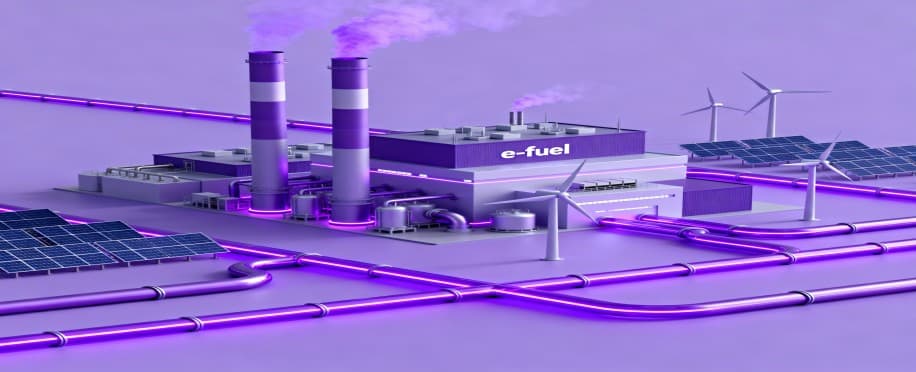
Low E-Fuel Production Delays Decarbonisation in Europe
When ambition outpaces fuel supplyAccording to an analysis by the activist NGO Transport & Environment (T&E), Europe's goals to decarbonise the maritime sector are hampered by the precarious nature of the alternative fuel supply chain.
Although Europe is a leader in decreasing shipping emissions, production of green hydrogen and e-fuels remains low. The only operational major e-fuel plant for the maritime sector started this year, while many other projects are halted due to regulatory uncertainty.
European E-fuel & Green Hydrogen Projects
T&E analysed 80 green hydrogen and e-fuels projects for the maritime sector in Europe, projecting a production of 3.6 million tonnes of oil equivalent by 2032. However, under five per cent of these projects are primarily focused on shipping, with only a minimal number related to operational initiatives.
Moreover, the NGO asserts that even though certain efforts have made progress, it is doubtful that the total production of shipping e-fuels would achieve the targeted levels unless additional legal incentives are implemented.
Due to the low supply, Europe is unlikely to reach its own goals of adopting at least 1% of e-fuels by 2031 and 2% by 2034 as stipulated in the FuelEU agreement.
Besides, only a few weeks have passed since the European Commission approved its Sustainable Transport Investment Plan (STIP), which lays out the strategy for quickening the energy transition for the aviation and maritime industries.
By 2035, Europe will require substantial amounts of about 20 million tonnes of sustainable alternative fuels (13.2 tonnes of biofuels and 6.8 tonnes of e-fuels) to satisfy the fuel requirements. By 2035, $120 billion in investments will be needed to boost production.
Europe's Market Trend Towards Sustainable Fuels
According to T&E, governmental support is crucial to de-risk innovative projects and direct the market towards fuels that are in line with Europe's aims, even though the private sector is anticipated to provide the majority of the investments.
Additionally, even while STIP is a step in the right direction for the e-fuels sector, its efficacy may be hampered by its reliance on instruments like the Innovation Fund and the European Hydrogen Bank auctions.
At the moment, Norway has the most fuel used, mostly for the maritime industry, followed by Denmark, Finland, and Spain. The primary end user for about 25% of Norway's predicted volumes is shipping, mostly via e-ammonia.
Regent Training Centre offers courses structured to enrich career-related knowledge throughout the spectrum, guiding graduates pursuing progression and managers intending to sharpen their proficiencies. The centre aims to foster continuous development, resilience, and success in today's dynamic business environment.
Operational Achievements
The largest active e-fuel project for the maritime industry is still the Kassø e-methanol project in Denmark, which started operations in May of this year. The plant, which was built by European Energy, can produce 42,000 tonnes of e-methanol annually and is now serving Novo Nordisk, Maersk, and the LEGO Group, among other companies.
Notably, Constance Dijkstra, T&E maritime policy manager, noted that current shipping targets lack ambition to attract investor capital, emphasising that fuel producers require substantial financial support alongside demand incentives. The largest maritime e-fuels project became operational this year, highlighting potential advancements; however, challenges persist in project scaling.
Overall, according to Dijkstra, Europe can strengthen its industrial leadership and lessen its reliance on imported fossil fuels by developing a robust e-fuels sector.
Read more news:
- NASA Hosts an Astronaut-Led Video Tour to Honour the ISS's 25th Anniversar
- The US has Halted Negotiations with the UK on a Technology Trade Deal
- Trump Initiates a $1 Million 'Gold Card' Visa Programme amid a Crackdown on Immigration
Posted On: December 24, 2025 at 08:32:30 PM
Last Update: January 31, 2026 at 09:46:46 PM
Articles You Can’t Miss
Handpicked content to fuel your curiosity.


