
Future Leadership Competencies Companies Will Pay For in 2026 (Based on Data)
Leadership is changing faster than ever. Companies are no longer paying for traditional management skills, but for leaders who can navigate uncertainty, transform teams, and drive outcomes in complex environments. Based on global hiring and compensation data, here are the leadership competencies companies are actively paying for in 2026.In This Article
Quick links to sections in this article.
Between 2023 and 2026, leadership roles underwent a major shift. The rise of hybrid teams, digital transformation, AI adoption, talent shortages, and market uncertainty changed how organisations define leadership success.
Today, companies are willing to pay more for leaders who can think strategically, lead through volatility, unlock team performance, and translate innovation into measurable results.
In this article, we’ll explore the future leadership competencies companies will pay for in 2026, based on workforce data, talent market insights, and corporate HR demand across multiple industries.
Why Leadership Competencies Are Changing
Leadership competencies today have changed because we (as humans) have changed. The growth and quickening change of business needs mean a leader needs to develop new abilities to keep up with them. What brought on this change of leadership pipeline? let's explore:
- Hybrid work: Leaders can no longer rely on physical presence, so they must manage outcomes, trust, and accountability instead of visibility.
- Real-time decision making: Faster markets force leaders to act with incomplete information and adjust decisions as conditions change.
- Cross-border teams: Global teams require leaders who can align people across cultures, time zones, and working styles.
- AI collaboration: Leaders now work alongside AI tools, which means understanding how technology supports decisions without removing responsibility.
- Psychological safety: Teams perform better when people feel safe to speak up, challenge ideas, and admit mistakes without fear.
What Companies Are Paying For in 2026
One key part of trend analysis is to check the market traits and read where the money is actually flowing to, and the results could shock you!
- Soft Skills Surpass Hard Skills: About 84% of candidates need to have soft skills (like leadership, communication, and empathy) that matter more than ever in an AI-driven workforce. In other words, even as digital tools advance, the uniquely human abilities of great leaders have become more, not less, important.
- Leadership & Social Influence in Demand: The World Economic Forum’s Future of Jobs report notes that 44% of core job skills will change by 2027, with “leadership and social influence” among the most in-demand abilities. Companies are investing in leaders who can influence, inspire, and guide teams through change.
- Coaching and People Development Gaps: Gartner’s HR research found that 60% of employees aren’t getting the on-the-job coaching they need for skill development. This skills gap is prompting organizations to pay extra for leadership competencies in mentoring and team development – those who can strengthen their people’s abilities.
- Tech-Savvy Leadership: McKinsey reports a surge in demand for AI-fluent managers. Job postings requiring AI and data literacy have increased nearly sevenfold in two years. Companies reward leaders who are comfortable with digital tools and can lead their teams through digital transformation. In fact, being future-ready often means blending technical capabilities with human judgment.
The moral of the story is: Companies are not paying for leadership because it sounds good on paper. They are paying for it because without strong leaders, strategy stalls, transformation slows, and performance suffers.
The Top Future Leadership Competencies in 2026
Now that you know that leadership competencies are critical for both business professionals and businesses, and you're set on being at the top of the food chain, take a look at what the data shows are the most important leadership competencies in 2026 and how each competency could make you successful:
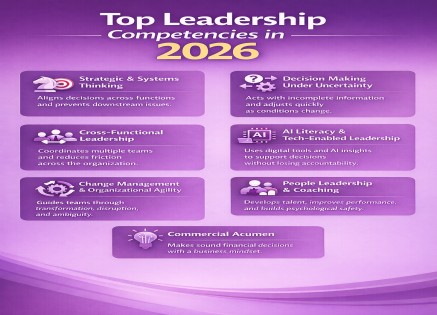
- Strategic Thinking & Systems Thinking
Companies pay for this strategic thinking competency because it prevents decisions that fix one problem while creating others elsewhere. A strategic leader who is effective themselves improves efficiency without harming employee workload or customer experience.
- Decision Making Under Uncertainty
Organizations value leaders who can act without perfect data and adjust quickly. A manager who makes supplier decisions during disruption by using scenarios instead of waiting is a manager who will advance in their career, as power is in being ready to act fast on their feet, and the ability to stick to them.
- Cross-Functional Leadership
Most work depends on multiple teams, and companies pay for leaders who reduce friction between them. Take a product leader, for instance: at the core of processing success, they need to align engineering, legal, and sales to launch on time. Now, think when you learn how to do that, your spot is untouchable then.
- AI Literacy & Tech-Enabled Leadership
Leaders who understand AI help their organization gain value without losing accountability. Humans are great, but why not strengthen your team with the best digital worker? Be a manager who uses AI insights for planning but validates decisions before acting.
- Change Management & Organizational Agility
Poor change leadership is costly, so companies pay for leaders who move people through change smoothly.
Leading means going forward even through challenges, and if you possess a skill to lead and inspire through change, then you're the good man in the storm; every company wants one of those.
- People Leadership & Coaching
Strong people leadership improves performance and retention, reducing hiring pressure. It's essential to turn feedback into clear actions that improve team output and, most importantly, make people feel like they matter.
- Emotional Intelligence & Social Intelligence
Leadership is human, and companies pay for leaders who manage emotions and relationships well, one whose behavioural competencies are at a level where they can resolve tension in a hybrid team before it affects results.
- Commercial Awareness & Business Acumen
Organizations reward leaders who make financially sound decisions at scale. An executive who evaluates initiatives based on risk, margins, and long-term value, which is why leadership development programs for executives focus on it.
Roles That Pay a Premium for These Competencies
Organizations consistently pay more for leadership competencies in roles with system-wide impact:
- Product and innovation leadership roles
- Operations and supply chain leadership
- Technology and digital leadership
- Risk, policy, and compliance leadership
- Business unit and general management roles
These positions require leaders who can integrate strategy, execution, and people leadership across multiple levels.
Skills Gap: Why Companies Can’t Find These Leaders
If these competencies are so crucial, why do companies struggle to find enough leaders who have them? The reality is there’s a significant skills gap in the leadership pipeline. Several factors contribute to this gap:
- Pace of Change: The business environment is evolving faster than traditional training and development can keep up. Managers were trained for a world that no longer exists, with only 36% of managers saying they were trained enough for the AI world transformation; the gap remains.
- Insufficient Development Opportunities: Companies themselves sometimes under-invest in leadership development. While the need for upskilling is recognized, implementation lags.
- High Demand, Low Supply: Simply put, everyone wants these well-rounded leaders, and there aren’t enough of them.
- Education Gaps: Traditional MBA programs or technical degrees historically focused on hard skills and knowledge, not always on soft leadership skills or interdisciplinary thinking. While this is changing, many current leaders did not formally grow or cultivate qualities like emotional intelligence or design thinking in school.
This gap between what organizations need and what the talent pool offers is why leadership development is such a hot topic. For example, in the McKinsey leadership survey, 83% of leaders believed leadership is key to navigating a skills-based future, but only 28% of employees felt their company’s strategy was clear to them.
That disconnect points to leaders not effectively communicating and executing change – a competency issue. Similarly, 87% of employees say fair feedback could even be done better by AI than by their human bosses, underscoring weaknesses in current leadership coaching and objectivity, according to Gartner’s Top Nine Workplace Predictions for CHROs in 2025.
How to Build These Competencies (Training Path and Upskilling)
Leadership competencies develop through intentional practice, not passive experience. The most effective paths combine formal learning with real responsibility.
- Invest in focused leadership education: leadership training courses in London expose professionals to global perspectives, executive frameworks, and real decision scenarios.
- Pursue cross-functional responsibility: Leading projects across departments strengthens strategic thinking and builds an understanding of how the organization operates as a system.
- Use coaching and structured feedback.
- Regular feedback and coaching accelerate growth, like the Strategic Leadership Programme, Digital Transformation Strategy, and the Organisational Development Masterclass
- Build digital and AI confidence.
- Using digital tools in daily work improves decision-making and prepares leaders to work effectively alongside technology.
- Commit to continuous development.
- The most effective leaders follow a learning path aligned with long-term career goals rather than relying on one-off training.
Regent delivers internationally accredited training courses tailored to local and global needs. With our regional offices based in London, Dubai, Barcelona, Paris, Istanbul, Kuala Lumpur, Singapore, and Amsterdam, we provide flexible training solutions and expert support wherever you are.
Conclusion: What Leadership Means in 2026
Leadership in 2026 is not about control or authority. It is about capability.
Companies pay for leaders who can think clearly, decide under pressure, lead people effectively, and work confidently with technology. These competencies shape performance, resilience, and long-term success.
For professionals, the message is clear. Build these capabilities deliberately, or risk falling behind.
Leadership today is measured by what you can handle, not by what you manage.
Posted On: January 19, 2026 at 08:52:18 PM
Last Update: February 16, 2026 at 07:08:36 PM
Strategic thinking, adaptability, people development, and tech-aware decision making. Leaders must set direction, guide change, coach teams, and use digital tools effectively.
Focus on one or two skills, combine structured learning with real work challenges, and ask for regular feedback. Leadership training courses in London are often used as a fast-track option.
Because modern leadership is people-driven. Leaders with strong emotional intelligence build trust, reduce conflict, and keep teams engaged, especially in hybrid and high-pressure environments.
You need digital awareness, not coding skills. Effective leaders understand how AI and data affect decisions and know how to work confidently in tech-enabled workplaces.
They improve retention, decision quality, and adaptability. Strong leadership development builds a reliable pipeline of capable managers and drives long-term performance.
Roles with broad impact, such as product leaders, operations leaders, technology leaders, and business unit heads, see the strongest returns from these competencies.
Yes. Mid-level managers who build these competencies early are better prepared for senior roles and are more likely to be promoted in fast-changing organizations.
Articles You Can’t Miss
Handpicked content to fuel your curiosity.